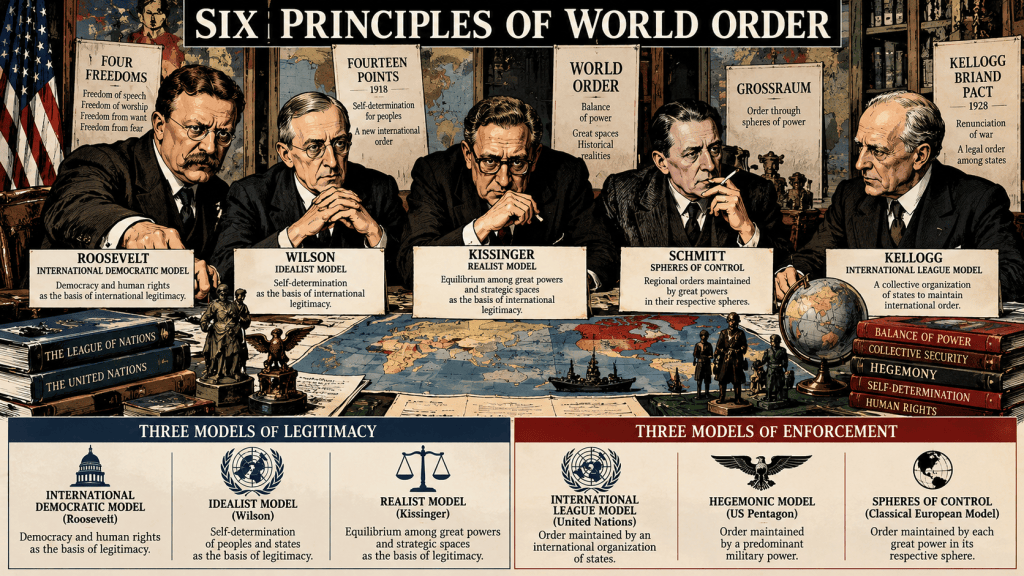
Modern international relations are governed by three competing principles of legitimacy.
1. The Realist Model — Kissinger
In World Order (2014), Henry Kissinger returned to a fundamental proposition of classical diplomacy: international order depends upon an equilibrium among major powers, each possessing its own historical experience, strategic interests and conception of legitimacy.
The relevant political units are not necessarily equal in power or influence. International stability emerges from arrangements that accommodate the distribution of power and prevent any single actor from overturning the system.
Its underlying principle resembles constitutional checks and balances, transposed to the international level.
Just as a constitutional system distributes authority among competing institutions, a realist international order distributes effective power among competing geopolitical centres.
Its hard core is equilibrium among great powers and their strategic spaces….
2. The Idealist Model — Wilson
Woodrow Wilson’s Fourteen Points of January 1918 expressed a fundamentally different conception……
Read more on the daily The World Newsreek


Rispondi